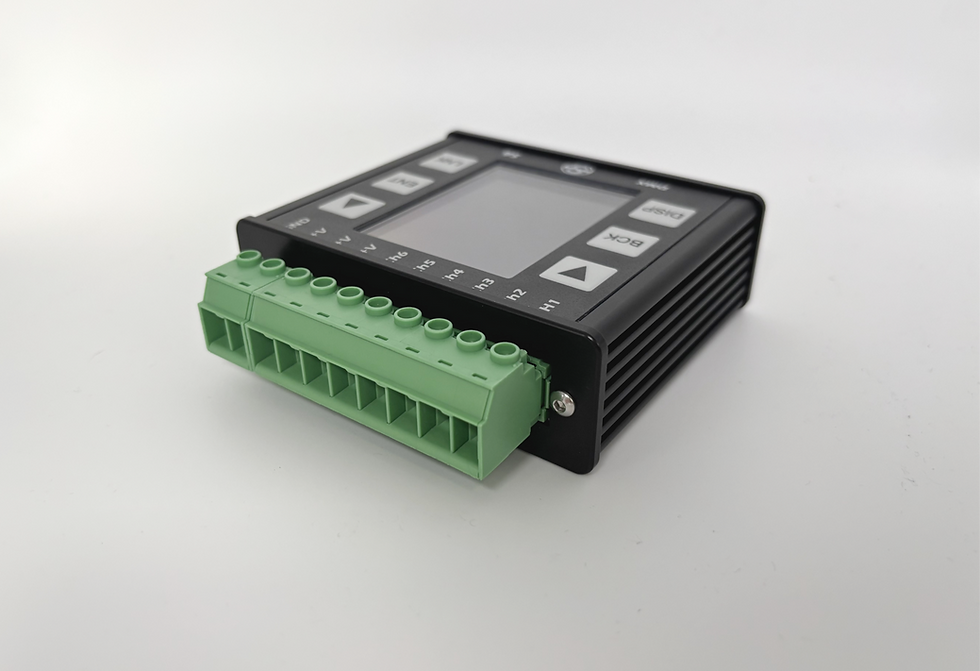
Behind the Development of the S6: Creating a Safer, More Powerful LED Controller
Updated: Jun 30
When developing a new product, the finished unit rarely tells the full story.
Behind every successful controller lies months of engineering, testing, problem-solving, and innovation. The development of the EMP Designs S6 LED Controller for LCA, was no exception. What began as a requirement for a higher-power LED controller evolved into a project that pushed multiple areas of engineering, from thermal management and mechanical design through to safety systems and intellectual property development.
This is the story of how the S6 was developed.

Defining the Challenge
The original objective seemed straightforward.
We wanted to develop a new LED controller capable of handling significantly more power than previous designs while providing greater flexibility for controlling larger LED installations across six independent channels.
However, increasing power capacity introduces a range of engineering challenges.
Higher currents require more robust connectors, larger power-handling components, improved thermal management, and careful consideration of user safety. As the project evolved, it became clear that the S6 would require innovation across several disciplines to achieve the performance and reliability standards we expected.
Selecting the Right Components
Every successful electronics project starts with component selection.
Working with a wide range of manufacturers and suppliers, we reviewed available connector technologies, power devices, display systems, and supporting components to identify the most suitable solutions for the S6.
One of the first challenges was finding connectors capable of safely handling the current levels required by the design. While many connectors appear suitable on paper, real-world performance, reliability, availability, and ease of installation all need to be considered.
At the same time, we wanted the controller to offer a visual user interface that would be simple and intuitive to operate. This led us to evaluate multiple display technologies before selecting a solution that provided the visibility, physical size, and graphical capability needed to create a user-friendly control system.
Solving the Thermal Challenge
One of the biggest obstacles when designing high-power LED controllers is heat.
Whenever large currents are switched, energy is lost in the switching devices and conductors. That energy becomes heat, and excessive heat is one of the primary causes of reduced reliability and shortened component life.
To overcome this challenge, we developed several new approaches within the hardware design.
Specially designed printed circuit boards were used to improve heat extraction from critical components. Thermal transfer materials were embedded within the PCB structure, allowing heat to move away from the power devices more efficiently.
Additional thermal vias beneath high-power components helped conduct heat through the board, while carefully selected thermal interface materials transferred that heat into the enclosure itself.
Designing a Custom Enclosure
Extracting heat from electronic components is only half the problem.
Once the heat reaches the enclosure, it still needs somewhere to go.
A common misconception is that simply attaching a large aluminium block to a device automatically solves thermal issues. In reality, if the heat cannot be effectively dissipated into the surrounding air, the aluminium simply continues to get hotter.
To address this, the S6 required a completely bespoke enclosure.
Rather than selecting an off-the-shelf housing, we designed a custom aluminium extrusion specifically for the project. The profile was engineered to maximise heat dissipation while maintaining a compact footprint suitable for installation environments.
This custom enclosure became a critical part of the controller's thermal management strategy, effectively turning the entire housing into a high-performance heatsink.
Looking Beyond Traditional Protection Systems
As development progressed, another challenge emerged.
Traditional LED controllers typically rely on overcurrent protection systems to detect faults. While effective in many situations, we identified scenarios where certain fault conditions could develop without triggering conventional protection methods.
This led us to ask an important question:
Could LED safety be improved?
Rather than accepting the limitations of existing approaches, we began investigating entirely new methods of fault detection.
After extensive development and testing, we created a unique system capable of identifying fault conditions within LED installations that conventional protection systems may not detect.
The result was so innovative that we applied for patent protection.
Today, the S6 incorporates patent-pending safety technology developed by EMP Designs, representing a fundamentally different approach to LED fault monitoring and protection.
Bringing Everything Together
Once the individual systems had been proven independently, the next challenge was integrating everything into a single production-ready design.
This stage involved:
Hardware integration
PCB layout optimisation
Firmware development
User interface design
Mechanical packaging
Thermal validation
Manufacturing preparation
As with most complex electronic products, multiple hardware revisions were required.
Each revision allowed us to identify improvements in component placement, copper distribution, assembly processes, thermal performance, and manufacturing efficiency.
Through repeated testing and refinement, the design gradually evolved into the final S6 production platform.
Synchronised PWM Technology
Another key feature incorporated into the S6 builds on technology previously developed by EMP Designs.
When multiple controllers are connected together using the integrated RJ45 networking connections, they do more than simply pass DMX data.
The controllers also exchange synchronisation information.
This ensures that PWM frequencies remain aligned across all connected units, preventing harmonic interactions that can occur when multiple high-power LED controllers operate from shared power supplies.
By synchronising PWM timing across the network, the S6 delivers more stable operation and improved system performance in larger installations.
From Prototype to Production
One of the advantages of developing products at EMP Designs is our ability to perform much of the development and manufacturing process in-house.
Throughout the S6 project we were able to:
Design and assemble prototype PCBs internally
Manufacture test hardware using our pick-and-place facilities
Machine prototype enclosures in-house
Evaluate thermal performance rapidly
Produce multiple hardware revisions quickly
CNC machine enclosure prototypes before committing to tooling
Before investing in extrusion tooling, prototype housings were produced to validate thermal performance and overall functionality.
Once the design had been fully proven, custom tooling was commissioned to manufacture the final aluminium extrusion used in production.
The user interface was completed with a custom membrane keypad specifically developed for the S6, providing a professional and reliable operator experience.
Four to Five Months of Intensive Development
From initial concept through to a production-ready design, development of the S6 took approximately four to five months.
The project required expertise across multiple disciplines, including:
Electronic hardware design
Thermal engineering
Mechanical design
Firmware development
User interface design
Manufacturing engineering
Component sourcing
Intellectual property development
The discovery and patenting of the new safety technology added additional complexity to the project but ultimately resulted in a product that delivers capabilities beyond the original specification.
The S6, More Than Just Another LED Controller
The S6 began as a requirement for a higher-power six-channel LED controller.
It became much more than that.
Through custom thermal engineering, a bespoke enclosure design, synchronised PWM technology, and patent-pending fault detection systems, the S6 demonstrates the approach EMP Designs takes to product development.
Rather than simply building products to meet a specification, we look for opportunities to solve problems differently, improve safety, and develop new technologies that genuinely benefit our customers.
The result is a controller that not only delivers more power but also introduces a new approach to LED safety and reliability.