

projects
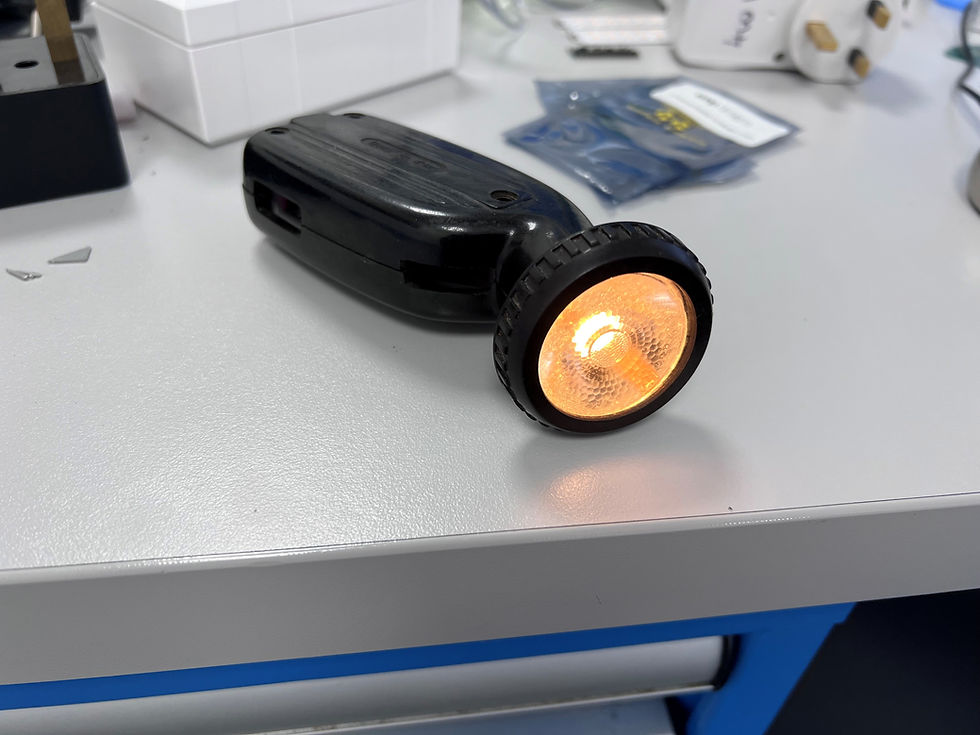
Torches are a familiar sight in adventure, military and action films. They may be used by actors to explore a dark location, search an area or provide the apparent light source within a scene.
Although a torch might look like a straightforward prop, making one perform reliably on camera can be surprisingly challenging. At EMP Designs, we are frequently asked to modify or create torches that retain the appearance selected by the production while providing the colour, brightness and control required by the lighting and camera teams.
Why Standard Torches Can Cause Problems on Camera
Productions will often choose an existing torch because it has the right shape, period styling or visual appearance for the character and scene. However, the electronics inside a commercially available torch are rarely designed with professional filming in mind.
One of the most common problems is flicker.
Many LED torches control brightness by switching the LED on and off extremely quickly. This may be completely invisible to the human eye, but the camera can detect it. Depending on the torch’s operating frequency, camera settings and frame rate, the result can be flickering, pulsing or scrolling bands of light across the image.
This can make an otherwise suitable prop unusable on set.
Getting the Right Colour of Light
The colour produced by a standard torch may also be unsuitable for the shot.
The original LED might appear too cool, too blue or simply fail to complement the other lighting being used within the scene. In other situations, the torch may need to reproduce the warmer appearance of an older incandescent lamp while still benefiting from the efficiency and controllability of modern LEDs.
The torch might be the primary source of illumination within the shot, particularly when lighting an actor’s face or a nearby area. Alternatively, it might act as a visible practical light while the majority of the scene is illuminated by additional fixtures positioned off-camera.
In either case, the torch needs to look convincing and integrate naturally with the production’s wider lighting design.
Remote Brightness and On/Off Control
Another frequent requirement is the ability to control the torch remotely.
Productions may need to:
Switch the torch on or off at a precise point in the action.
Adjust its brightness without touching the prop.
Repeat the same lighting cue consistently across multiple takes.
Coordinate the torch with other lighting effects within the scene.
Relying on an actor to operate a small physical switch can make it difficult to achieve precise timing. It can also create continuity problems if the torch is not operated in exactly the same way during every take.
Remote radio control gives the lighting team much greater control over the result while allowing the actor to use the torch naturally as part of the performance.
Developing Bespoke Torch Controllers
EMP Designs has spent considerable time developing compact electronic controllers specifically for LED torch applications.
Depending on the LED and the original torch design, the controller may operate using constant voltage or constant current. In every case, the electronics are designed to be small enough to integrate into a standard or production-selected torch body.
The controller can provide:
Stable, camera-friendly LED operation.
Smooth brightness adjustment.
Remote on/off control.
Radio-controlled operation.
Repeatable lighting cues.
Compatibility with a carefully selected LED and colour output.
The aim is to retain the external appearance of the original torch while replacing or adapting the internal electronics to make it suitable for professional filming.
Custom LED Boards and Complete Retrofits
There are several ways we can approach a torch project.
For some applications, we design a custom LED board that fits the torch body, together with a separate control board. This allows us to select the LEDs, colour characteristics and electrical design specifically for the production.
In other cases, the client provides the finished torches they want to use. We then retrofit the required LED, controller and radio-control electronics inside the existing housing.
This approach is particularly useful when the appearance of the torch is important. The production can retain the exact prop selected by the art or costume department while gaining the control and camera performance needed by the lighting team.
Combining Period Styling with Modern Control
One example is a military-style torch based on designs used during the early 1900s. This type of lamp has appeared in a number of military film productions because its distinctive shape complements the period being portrayed.
Externally, it retains the appearance expected of a historical military lamp. Internally, however, it can be fitted with modern LED and control technology.
This combination allows the torch to remain visually appropriate for the production while providing reliable colour, brightness and remote operation on set.
Practical Lighting Designed Around the Production
Every torch project is slightly different. The available internal space, battery arrangement, required brightness, LED type and chosen housing can all affect the final design.
Our role is to develop a solution around those constraints.
Whether we are creating a new LED assembly or modifying an existing prop, the goal remains the same: to produce a well-coloured, stable and fully controllable torch that performs reliably in front of the camera.
The finished result may look like a conventional, vintage or military torch from the outside, but inside it contains electronics designed specifically for use on film and television productions.
Unsolved Problem
Collaborate and discuss requirement with client. Overview full scope, context, and constraints. Research and analyse.
INVENTION
Converge knowhow, technology and creativity to find solution. Create first design. Work with client to finalise spec.
DESIGN DETAIL
Full detailed design stage – electronic, mechanical, technological, systems …
REVIEW
Review 3D data and concepts with client. Revise and tweak.
PROTOTYPE
Release all files for prototyping. Assemble product parts. Program, test and trial.
DEVELOP
Evaluate in live environment, consider any current or future developments.
BUILD
Build quality product – in-house for small, specific batches or manage manufacturing through our expert suppliers. EMP personally test & ensure highest quality products and packaging.