Practical Lighting Without the Wiring Nightmare. Making the LV966 work for you.
Introducing the LV966 96-Channel LED Controller for Film, TV, Theatre, and Immersive Installations.
As practical lighting becomes more advanced across film production, television, theatre, immersive experiences, escape rooms, exhibitions, and scenic design, one challenge continues to slow projects down:
Complex LED wiring.
Large LED installations often require:
hundreds of resistors
extensive soldering
bulky cable looms
time-consuming troubleshooting
difficult DMX integration
What starts as a creative lighting concept can quickly become a technical bottleneck.
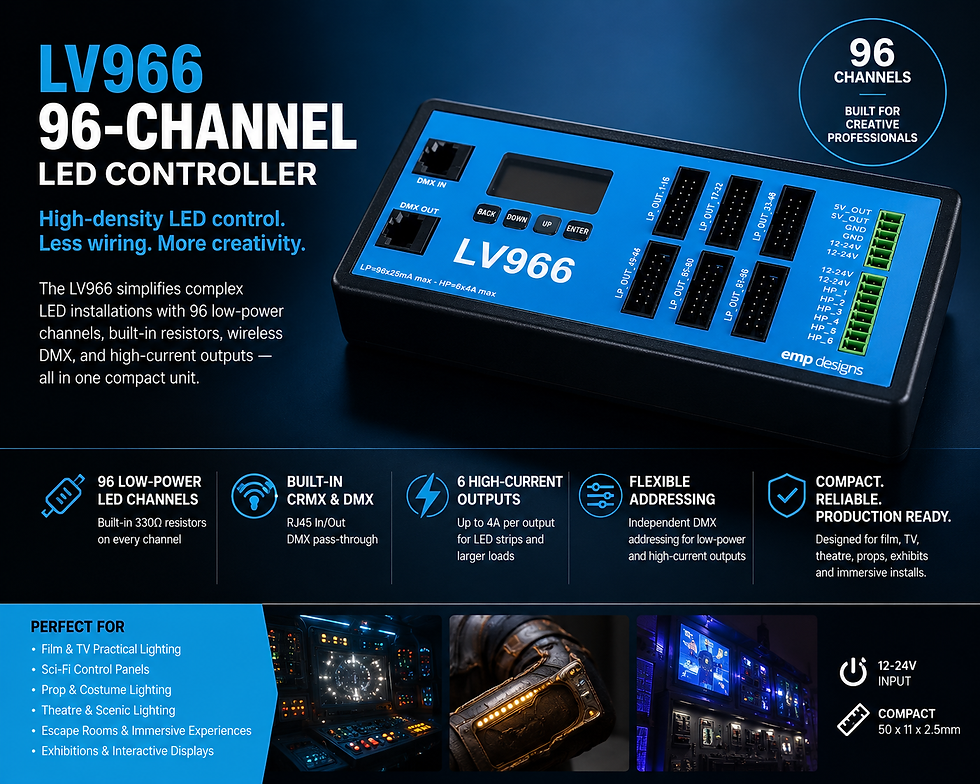
The LV966 96-Channel LED Controller was developed to solve exactly that problem.
Originally designed for Sci-Fi console and control-panel lighting used in professional productions, the LV966 has evolved into a powerful LED control solution for high-density practical lighting installations where reliability, speed, flexibility, and clean integration are essential.
What Is the LV966?
The LV966 is a compact 96-channel LED controller designed for:
practical lighting
prop lighting
control panels
miniature lighting
scenic lighting
immersive installations
interactive displays
Unlike conventional LED controllers, the LV966 includes integrated 330Ω resistors on every low-power output channel, dramatically reducing installation complexity.
The controller also supports:
DMX control
CRMX wireless DMX
high-current outputs
flexible addressing
12–24V operation
This makes it ideal for both temporary production environments and permanent installations.
96 LED Channels with Built-In Resistors
At the core of the LV966 are 96 individually controllable low-power LED outputs.
Each channel includes a built-in 330Ω resistor directly on the controller board.
This eliminates one of the most repetitive and failure-prone aspects of LED installations: manually adding resistors to every LED.
Benefits of Integrated LED Resistors
Using onboard resistors provides several major advantages:
Faster installation times
Reduced soldering
Cleaner wiring layouts
Fewer connection points
Simplified troubleshooting
Improved long-term reliability
Easier maintenance
Reduced cable management
For productions working to tight deadlines, this can significantly reduce build time while improving overall reliability.
Whether you're creating:
spaceship consoles
illuminated props
cockpit dashboards
interactive exhibits
scenic practicals
architectural miniatures
…the LV966 helps simplify complex LED systems.
Designed for Professional Practical Lighting Applications
The LV966 was specifically developed for environments where:
space is limited
channel counts are high
reliability is critical
installations must remain serviceable
Common Applications Include
Film and television practical lighting
Sci-Fi control panels
Prop lighting systems
Cockpit and dashboard lighting
Theatre scenic lighting
Escape room installations
Museum exhibits
Exhibition displays
Interactive experiences
Architectural miniatures
Model lighting systems
Live event installations
By combining high channel density with integrated wireless control and onboard resistors, the LV966 allows lighting designers, prop makers, scenic artists, and technicians to spend less time managing infrastructure and more time focusing on creative lighting design.
Built-In CRMX and DMX Control
Modern productions require flexible lighting control systems.
The LV966 supports both:
hardwired DMX
integrated CRMX wireless DMX
This allows seamless integration into professional lighting workflows.
Connectivity Features
DMX input via RJ45
DMX pass-through
Built-in CRMX receiver
Wireless practical lighting control
Wireless DMX capability is particularly valuable for:
moving props
portable scenic elements
temporary sets
immersive experiences
difficult cable runs
live productions
By reducing physical cabling requirements, the LV966 helps accelerate installation and strike times while maintaining professional-grade control.
Six High-Current Outputs for Larger Lighting Loads
In addition to its 96 low-power LED channels, the LV966 includes six high-current outputs capable of supplying up to 4A each.
These outputs can drive:
LED strip lighting
accent fixtures
practical fixtures
larger lighting elements
powered scenic lighting
This combination of precision LED control and higher-current capability allows the LV966 to manage both detailed practical lighting and larger scenic lighting elements from a single compact controller.
Flexible DMX Addressing for Complex Installations
Complex lighting systems require flexible control structures.
Using the onboard menu system, users can independently assign DMX addresses for:
low-power outputs
high-current outputs
This allows:
grouped lighting behaviour
offset channel mapping
synchronised lighting effects
independent scene control
scalable installations
The result is a controller that adapts easily to both simple and highly advanced lighting systems.
Built for Modern Production Workflows
Professional productions need lighting systems that are:
fast to deploy
reliable under pressure
compact
easy to maintain
flexible to control
The LV966 was designed specifically for these requirements.
Operating from a 12–24V input and featuring an onboard regulated 5V supply, the system supports direct connection of individual LEDs while remaining suitable for portable rigs, touring installations, and permanent scenic builds.
Why the LV966 Simplifies Practical Lighting
Traditional LED installations can become difficult to manage as channel counts increase.
The LV966 reduces:
installation time
soldering requirements
wiring complexity
troubleshooting workload
physical cable bulk
At the same time, it increases:
reliability
scalability
flexibility
installation speed
creative control
For lighting professionals working in film, television, theatre, immersive design, exhibitions, and live events, this creates a faster and more efficient workflow from concept through to final installation.
Frequently Asked Questions
What is the LV966 used for?
The LV966 is a professional 96-channel LED controller designed for practical lighting, prop lighting, scenic lighting, immersive installations, and control-panel applications.
Does the LV966 support wireless DMX?
Yes. The LV966 includes built-in CRMX wireless DMX support alongside wired DMX connectivity.
Does the LV966 require external resistors?
No. Each low-power LED channel includes an integrated 330Ω resistor, reducing wiring complexity and installation time.
Can the LV966 control LED strips?
Yes. The controller includes six high-current outputs capable of driving LED strips and other higher-powered lighting elements.
What industries use the LV966?
The LV966 is suitable for:
film production
television
theatre
exhibitions
escape rooms
immersive experiences
museum installations
live events
scenic fabrication
Simplifying Complex LED Installations
As practical lighting becomes increasingly important in visual storytelling and immersive environments, the need for scalable and reliable LED control continues to grow.
The LV966 was designed to simplify large-scale LED installations without sacrificing creative flexibility or professional control.
From cinematic control panels to interactive scenic environments, it provides a cleaner, faster, and more reliable way to build sophisticated practical lighting systems.
Because practical lighting should support creativity — not slow it down.